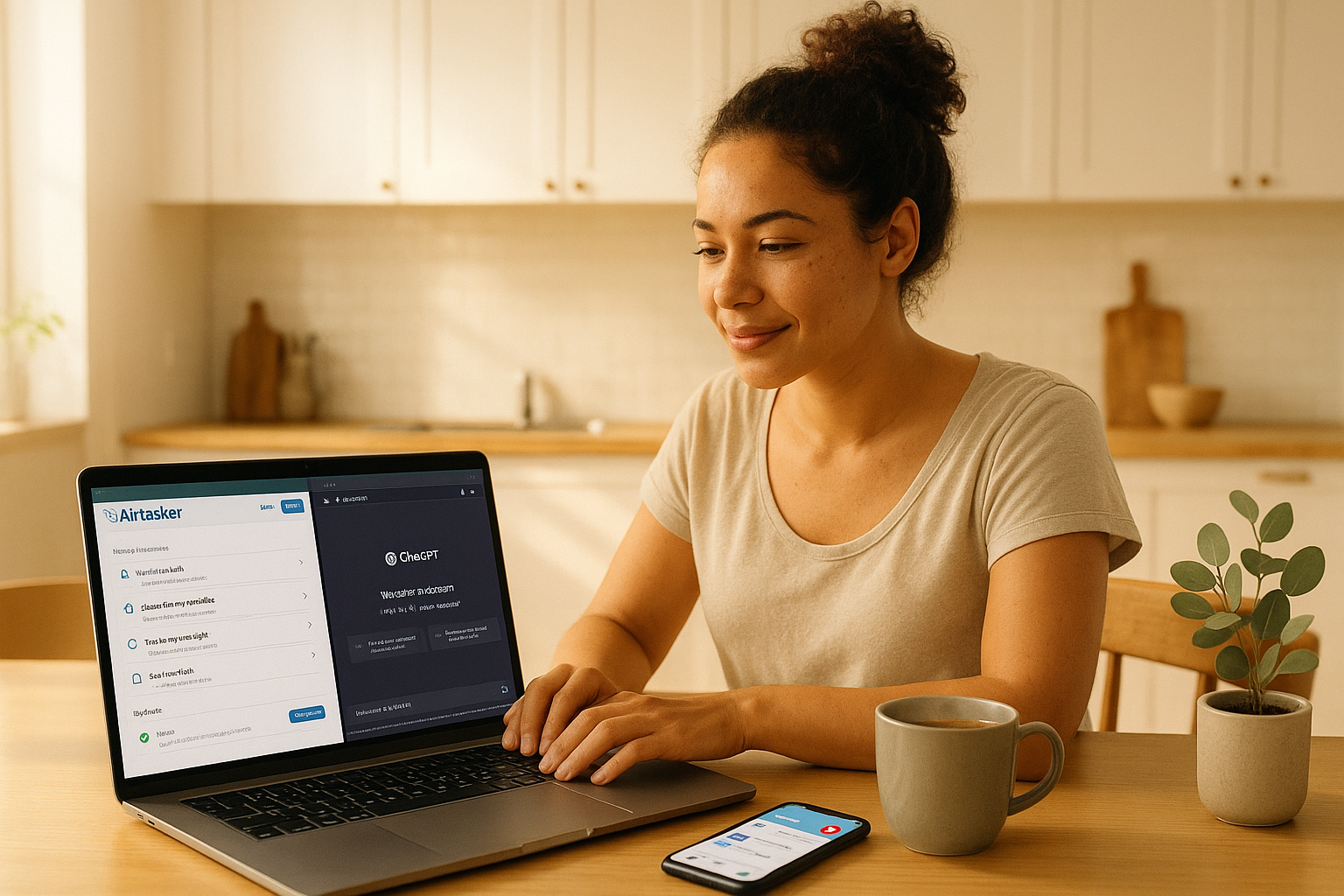
How to Use AI to Find and Complete Airtasker Jobs Faster (And Earn More Per Week)

SC

Admin

How to Use AI to Find and Complete Airtasker Jobs Faster (And Earn More Per Week)

How to Use AI to Find and Complete Airtasker Jobs Faster (And Earn More Per Week)

Most Airtasker guides will tell you to respond quickly and write a friendly bio. What they won't tell you is that the average offer message on the platform reads like it was bashed out in thirty seconds — because it usually was. "Hi, I can do this for you, please pick me." That's the competition. And if you've ever wondered why a new Tasker with no reviews struggles to win anything, that copy-paste flood is a big part of it.

The interesting bit is that almost nobody is using AI to fix it. While everyone else is grinding through cleaning jobs and furniture removals, a quieter group of Taskers are using ChatGPT and Claude to win more bids, deliver digital work in a fraction of the time, and turn Airtasker from manual labour into something closer to a partly-automated side hustle.

General information only. Income figures in this article are estimates based on publicly available reports and community discussions — results vary significantly based on effort, niche, and market conditions. This is not financial, legal, or tax advice. For guidance specific to your situation, consult the ATO, a registered tax agent, or a qualified professional.

Why Airtasker + AI Is an Underrated Combination

Here's the thing most people miss about the Airtasker AI side hustle in Australia: the platform openly hosts categories like "Computer & IT," "Design," and "Business" right alongside the cleaning and removals gigs. These are exactly the tasks where AI gives you a genuine edge — and they attract far less competition than the physical work everyone fights over.

A typical "write five product descriptions" task posted at $120 might take ninety minutes if you're writing from scratch. With ChatGPT drafting and you editing for accuracy and brand voice, it's twenty to thirty minutes. Same pay, a third of the time. Do that consistently and your effective hourly rate stops looking like gig work and starts looking like freelancing.

The realistic range for someone treating this seriously, part-time, is roughly $300–$1,500 AUD/month — but those two ends represent very different people. The $300 end is someone in their first couple of months, still building reviews, losing bids before their profile has any traction. The $1,500 end is someone six to twelve months in, specialising in digital tasks, using AI to take on more volume without burning out. Most people land somewhere in the $600–$900 range once they've got twenty-odd reviews and know which tasks to chase.

Which Tasks Are Worth Your Time (And Which Aren't)

Not every task suits AI. The sweet spot is anything text-heavy, research-based, or template-driven: copywriting, blog posts, product descriptions, data entry, spreadsheet cleanup, market research, email drafting, basic flyer and social-tile design, resume and cover letter writing.

That last one is a category worth lingering on — there's enough demand that some people build an entire AI-powered resume and LinkedIn writing service for Australian job seekers off the back of it, using Airtasker as the lead source.

Avoid anything requiring physical presence, a trade licence, or hands-on judgement AI can't fake. And worth noting: Airtasker's bundled Chubb public liability cover applies to "certain task activities" — generally physical ones. Digital work tends to fall outside it, which sounds like a downside but isn't. No ladders, no breakages, no insurance anxiety. Lower barrier, lower risk.

The counterintuitive part? The least glamorous tasks often pay best per minute. Data entry feels beneath people, so fewer Taskers bid, and the ones who do charge manual-labour rates. With AI-assisted formatting, you finish in half the time at a better margin.

How to Use AI to Find and Complete Airtasker Jobs Faster (And Earn More Per Week)

Setting Up a Profile That Actually Wins Offers

Airtasker's own copy says posters evaluate you on "transaction-verified ratings, reviews, completion rating, skills badges and portfolios." Translation: with zero reviews, you're competing almost purely on price. With a 4.9-star profile and a strong completion rate, you can charge a premium for identical work.

So the first five to ten jobs matter more than any others you'll ever do. The strategy that comes up again and again in Australian gig communities is simple: take your first three to five tasks at slightly below market rate, deliver them flawlessly, bank the five-star reviews, then raise your prices. You're buying social proof, not chasing profit, in those opening weeks.

Use AI for the bio too. Feed ChatGPT your actual skills and ask for three short, specific profile versions — then pick the one that sounds like you, not a corporate brochure. Specific beats slick. "I write clean, SEO-friendly product copy and turn spreadsheets around same-day" lands better than "passionate, hardworking professional."

The Offer Message Workflow That Beats Copy-Paste

This is the single biggest lever a new Tasker can pull, and almost nobody does it well.

Posters consistently say they ignore generic bids and pick Taskers who reference specific details from the task. So your job is to write a personalised three-sentence offer for every bid — and AI lets you do that in about sixty seconds instead of five minutes.

The workflow: paste the full task description into ChatGPT or Claude with a prompt like — "You're an experienced Airtasker Tasker. Write a warm, confident 3-sentence offer message for this task. Reference one specific detail from the description, state how I'll deliver it, and give a realistic timeframe. No fluff, Australian English." Then paste the task.

You'll get a tailored draft. Read it, tweak one line so it sounds human, send. The tone-matching matters: keep it professional for "Business" tasks, warmer for personal ones like writing a wedding speech. Over a week of bidding, that's the difference between a 10% and a 30% acceptance rate.

One more AI use here that protects your money: before you start, get the tool to draft a quick scope-confirmation message — "Just confirming you need X, Y and Z delivered as a Word doc by Friday." Because Airtasker Pay holds the agreed amount in escrow and only releases it when the poster marks the task complete, delivering exactly to spec the first time is how you actually get paid.

Pricing So the Service Fee Doesn't Eat You Alive

Here's what trips up new Taskers: Airtasker's service fee comes off your payment, not the poster's. The exact rate has shifted over the years — historically a tiered structure reported around 10–20% depending on task value, but check the current figures at the Airtasker Help Centre because they change.

The practical maths: a task posted at $100, with a ~15–20% fee, nets you somewhere around $80–$85. If you bid at the posted budget without accounting for that, you're quietly earning less than you think. Experienced Taskers factor the fee in from day one.

AI helps here too — ask it to research typical going rates for a task type before you bid, so you're anchored to the market rather than guessing. Because you're delivering faster than manual competitors, you can often price slightly above the cheapest bidder while still finishing first, which improves both your margin and your review velocity.

A Realistic Weekly Rhythm

Consider a composite based on common experiences. Priya, in Adelaide, works four days a week in admin and wanted extra income without leaving the house at night. She focused entirely on "Business" and "Design" tasks.

Her week looks like this: thirty minutes each evening scanning new digital tasks and firing off six to eight AI-assisted personalised offers. Out of roughly ten offers a week, she wins four to five tasks. Each takes between twenty minutes and an hour of actual work — a batch of product descriptions, a tidied-up customer database, a couple of Canva flyers built from a ChatGPT-generated brief.

Weeks one to four were about reviews, not revenue — she netted maybe $180 that first month, deliberately underpricing to bank five-star ratings. By month four, with eighteen reviews and a 100% completion rate, she was clearing closer to $750 a month for around five hours of work a week. Not life-changing. But a genuinely good return on the time.

The Tax Reality You Can't Skip

Every dollar you earn on Airtasker is assessable income the ATO expects you to declare, whether or not you ever receive a formal payment summary. Gig workers on the platform are generally treated as independent contractors, not employees — so you're responsible for your own tax.

As general guidance, business.gov.au indicates you should register for an ABN (it's free) once you're operating in a business-like way, even casually. Whether your situation crosses that line is worth thinking through — this breakdown of whether you need an ABN for AI side income walks through what the ATO actually requires.

GST registration only becomes compulsory once your turnover across all business activity hits $75,000 AUD a year — well above most part-time Taskers — but verify current obligations at ato.gov.au or with a registered tax agent. Keep records of everything: income, plus deductible expenses like phone data and your AI subscription (Claude Pro or ChatGPT Plus at whatever the current rate is when you're reading this). When it's time to lodge, this guide on declaring AI side hustle income on your Australian tax return covers the deductions side properly.

Turning One-Off Gigs Into Something Bigger

The Taskers earning at the top of that range — $1,200 to $2,000+ a month — rarely do it on Airtasker volume alone. They use the platform as a client-acquisition channel. A poster who loved your product descriptions this month needs more next month, and the month after.

Airtasker keeps payments on-platform, with no cash-in-hand permitted, so handle ongoing relationships within their terms. But there's nothing stopping a happy client from posting their next task and inviting you directly. That repeat work — predictable, no bidding, no fee surprises once you understand the structure — is where Airtasker stops being a gig grind and starts becoming a small, real business built on the back of AI doing the heavy lifting.

SC
Admin

Author

Related Posts

Offering AI-Powered Resume and LinkedIn Writing Services to Job Seekers in Australia

A Sydney HR coordinator I'll call Priya started rewriting resumes on Airtasker in her spare time for $80 a job. The first month was rough — she made maybe $340 after accounting for the hours she sank into each one, less than minimum wage if she's honest about it. But six months later she was charging $320 for a resume-and-LinkedIn combo, had a small waitlist, and was turning away the low-ballers. The thing that changed wasn't her writing talent. It was that she'd built a repeatable system using AI to do the heavy lifting, and learned to spend her own time only where it actually mattered.That's the gap most people miss. Every month the ABS releases fresh Labour Force data, and there are consistently hundreds of thousands of Australians in job transition at any given time — people who are motivated, anxious, and willing to spend $200 to feel like they've got a fighting chance. Almost none of them have a resume that reflects the Australian market properly. That's your market.General information only. Income figures in this article are estimates based on publicly available reports and community discussions — results vary significantly based on effort, niche, and market conditions. This is not financial, legal, or tax advice. For guidance specific to your situation, consult the ATO, a registered tax agent, or a qualified professional.Why people pay for this when AI is freeThe obvious objection: anyone can paste their job history into ChatGPT and ask for a resume. True. But most people don't, and the ones who try quickly discover the output is generic, weirdly American, and somehow makes them sound like everyone else. ChatGPT and Claude both default to US conventions — a one-page limit, an "objective statement" up top, the wrong date format. Australian resumes don't work that way. We don't include photos, age, or date of birth. Experienced candidates run to two or three pages. And the whole document lives or dies on quantified achievements, not buzzwords.So what you're really selling isn't "AI writing." It's translation and judgement. You're the person who knows that a FIFO maintenance fitter's resume needs to foreground tickets and safety records, that an aged-care worker's needs to emphasise compliance and empathy in equal measure, and that an Australian Public Service application isn't a resume at all — it's a pitch document addressing Work Level Standards. AI doesn't know any of that. You do, or you can learn it.What the service actually includesAt its simplest, you're offering three things: a rewritten resume, a cover letter tailored to a specific role, and a LinkedIn profile rewrite. Most clients want some combination. The LinkedIn piece matters more than people expect — recruiters live on the platform, and a profile that mirrors the resume's strengths (without copying it word-for-word) is genuinely valuable. Positioning yourself as an AI LinkedIn profile writer in Australia who understands how local recruiters search is a real differentiator.The premium tier is where the money is, though. An APS selection-criteria response — written in the STAR format, addressing the right capabilities — can command $300 to $600 because job seekers know the stakes and know they'll fumble it alone. Same logic applies to executive-level resumes. These take longer, but the per-hour return is far better than churning out $150 jobs.The tools, and where they stopYour engine will be ChatGPT or Claude. Both are capable; many people find Claude slightly better at longer, more nuanced drafting, while ChatGPT is faster for quick iterations. You'll want a paid plan for either — ChatGPT Plus or Claude Pro at whatever the current rate is when you're reading this — because the free tiers throttle you mid-project. For formatting, Canva Pro gives you clean, ATS-friendly templates without needing design skills.The piece most beginners skip is ATS optimisation. Applicant tracking systems scan resumes before a human ever sees them, and a beautifully written document that the software can't parse is useless. Running a draft through a tool like Jobscan shows you how well a resume matches a specific job ad's keywords. It's a small step that lets you tell clients, truthfully, that their resume is optimised for the systems that screen them. That sentence alone justifies a higher price.If you're already comfortable using AI for paid writing work, a lot of the same instincts carry over — it's worth reading how Australian freelancers are using ChatGPT to land $50/hour writing gigs on Fiverr, because the workflow discipline is identical.A workflow that takes under an hourHere's the shape of it once you're practised:Intake. Send a structured questionnaire — current role, target roles, three to five achievements with numbers attached, and the actual job ad they're chasing. The numbers are everything; AI can't invent that "reduced processing time by 30%" line, only you can prompt the client to surface it.Draft. Feed the questionnaire and job ad into your AI tool with a detailed prompt specifying Australian conventions, two-to-three pages, no photo, achievement-led bullet points.Human rewrite. This is the non-negotiable layer. You read every line, kill the robotic phrasing, fix the Americanisms, and inject the industry specifics the AI got wrong.ATS check and format. Run it through Jobscan, adjust keywords, drop it into a clean Canva template.Deliver and revise. One round of revisions included.The strategy call — even a quick 15-minute phone chat — is where you extract the nuance no questionnaire captures. It's also why your service feels human and a $5 Fiverr mill doesn't.Why the human edit protects youOn freelance forums, a recurring frustration is that AI-generated resumes are increasingly getting flagged — some hiring managers and ATS platforms are starting to detect the tell-tale rhythm of unedited machine text. If your service ships raw AI output, you'll get burned by it. The honest, defensible position is this: "I use AI as a research and drafting tool, but every document is written and edited by a human who understands your industry." That sentence is your entire competitive moat. Build the editorial process that makes it true.What to chargeMost successful operators land on three tiers:Basic resume rewrite — $150–$200Resume + LinkedIn combo — $280–$350Premium package (cover letter, LinkedIn optimisation, and a 30-minute strategy call) — $450–$550APS pitches and executive resumes sit above all of this as separate quotes. Don't apologise for these prices. A resume that helps someone land a $90,000 role is a rounding error against their first fortnight's pay.As for income: in your first three months, expect $500–$800 AUD a month — roughly three to six clients at entry pricing while you build reviews. By the six-to-twelve-month mark, eight to twelve clients a month on combo packages, with referrals kicking in, puts you in the $1,500–$2,500 range. The top 10% who add executive and APS work, run a small social presence, and maintain a waitlist push toward $3,500–$5,000+. None of that is guaranteed, and your first few Airtasker jobs will almost certainly pay below minimum wage once you count the hours. That's the apprenticeship.Where the Australian clients areAirtasker is the natural first port of call — it's homegrown, skews local, and resume tasks appear regularly. It takes a service fee of roughly 10–20% depending on the job. The early game is brutal on price; people accept $50–$80 jobs purely to bank ten five-star reviews, then raise rates. Treat those first jobs as marketing spend, not income.Beyond Airtasker, the most underserved niche is migrants and international students who need overseas experience reframed for Australian employers. The cultural translation is genuinely hard, the stakes are high (often tied to visa conditions), and these clients happily pay $250–$400. You'll find them in Facebook community groups and on LinkedIn. For broader market context and the language recruiters actually use, browsing live ads on Seek keeps your keyword instincts sharp.The business side, kept simpleYou'll need an ABN — it's free at abr.gov.au and takes about ten minutes. If you're unsure whether your situation requires one, this breakdown of whether you need an ABN for AI side income walks through what the ATO actually expects in 2026.You don't register for GST until your turnover hits $75,000 a year — the ATO threshold. At $250 a client, that's 300 clients in twelve months, well beyond where most side-hustlers land, so you'll likely invoice without adding GST for a long while. Verify your current obligations at ato.gov.au or with a registered tax agent. For payments, both Stripe and PayPal work, though many practitioners prefer direct bank transfer to dodge the 1.75–2.9% processing fees.One thing people get wrong: there's no "hobby threshold" for services income. As general guidance, every dollar you earn must be declared on your tax return, even in month one. The upside is the deductions — your AI subscriptions, Canva Pro, a portion of home internet and electricity, and any resume-writing courses are all generally claimable. The full picture of declaring AI side hustle income and claiming deductions is worth reading before your first BAS-free tax time.Resume writing is unregulated across every state and territory — no licence required — which keeps the setup refreshingly light. For context on employment standards you might reference when advising clients, Fair Work is a solid free resource.The operators who last aren't the fastest writers. They're the ones who treat AI as a drafting assistant, keep a human firmly in the loop, and pick a niche — APS, migrants, mining, aged care — where their judgement is worth paying for. Start there, bank your reviews, and raise your rates the moment you've earned the right to.

SC Admin

How to Earn Extra Cash Doing AI Data Labelling and Model Training Tasks From Home in Australia

How to Earn Extra Cash Doing AI Data Labelling and Model Training Tasks From Home in AustraliaIn her first month on Remotasks, a Brisbane primary school teacher named Sarah earned $43 USD — roughly $66 AUD once PayPal had taken its cut on the conversion. She'd read a few breathless articles promising "$30 an hour from your couch" and felt, understandably, a bit ripped off. What those articles didn't mention is that by month six, working two platforms and having qualified for higher-tier language tasks, she was clearing closer to $700 AUD a month. The disappointing start wasn't a sign she'd failed. It was just the shape of how this work actually pays.That gap — between the headline rate and what lands in an Australian bank account — is the whole story here, and it's the part most articles skip entirely.General information only. Income figures in this article are estimates based on publicly available reports and community discussions — results vary significantly based on effort, niche, and market conditions. This is not financial, legal, or tax advice. For guidance specific to your situation, consult the ATO, a registered tax agent, or a qualified professional.What you're actually doing when you "train AI"Every large language model and image generator you've used was taught by people doing repetitive, often tedious human work. Someone drew boxes around pedestrians so a self-driving car could recognise them. Someone transcribed garbled audio. And increasingly, someone read two AI-generated answers to a question and judged which one was more helpful, more accurate, or less likely to cause harm.That last category — ranking and evaluating model outputs — is called RLHF, or Reinforcement Learning from Human Feedback, and it's where the real money in this space has moved. Companies like OpenAI, Anthropic and Google can't build better models without humans grading the output. They pay platforms, who pay contractors, who are increasingly people sitting at kitchen tables in Adelaide and Newcastle.The work splits roughly into two tiers. Basic annotation — image tagging, bounding boxes, audio transcription — is the entry rung, and frankly it's being squeezed. It pays $3–$8 USD an hour equivalent, it's heavily offshored, and parts of it are being automated by the very models it once trained. The higher tier — evaluating LLM responses, writing adversarial prompts, fact-checking model output — pays meaningfully more because it needs strong written English and genuine judgement. That's the bit Australians are well-placed for, and it's the bit worth aiming at.Is it legit, and what does it really pay in AUD?Short answer: yes, it's legitimate, but the income is modest and uneven, especially early on.Here's the realistic trajectory I see in the data annotation jobs Australia space. In your first one to three months on micro-task platforms like Toloka or Amazon Mechanical Turk, expect somewhere between $150 and $300 AUD a month. That assumes you're logging in consistently and the exchange rate is being kind to you — most tasks are priced in USD, and at roughly 0.65 AUD/USD, a $15 USD hourly rate becomes about $23 AUD before fees.Six to twelve months in, working across two or three platforms and handling higher-complexity NLP and audio tasks, $500–$900 AUD a month is a fair expectation. The top 10% — people with demonstrated RLHF skills, domain expertise, or who've qualified for expert annotation queues — push into $1,500–$1,800 AUD a month at rates of $25–$45 USD an hour. That ceiling is real, but it's earned over months, not weeks, and it's not the median experience.Let me do the maths nobody else does. Say you complete 10 hours of Remotasks work this month at $15 USD an hour. That's $150 USD. PayPal converts it at a rate roughly 3% below mid-market, so you receive about $145 USD worth of value, landing as roughly $94 AUD. Then it's assessable income, taxed at your marginal rate. If you're already earning a salary and this sits on top at 32.5%, your take-home from that batch is closer to $63 AUD. Still worth having — but a long way from "$15 an hour."Platforms that actually accept AustraliansAppen was the obvious starting point for years — it was founded in Sydney in 1996 and built the local industry. I'd be doing you a disservice not to flag that the company has had a brutal few years: its share price collapsed from over $40 AUD in 2020 to under $1 by 2024, and Australian contractors on Whirlpool have repeatedly described projects being cancelled mid-engagement during its 2023–2024 restructuring. You can still find work through appen.com, but treat it as one option among several, not a stable employer.TELUS International (which absorbed Lionbridge's AI work) is now one of the more active platforms for Australians, with "AI Trainer" and "Search Engine Evaluator" roles that are among the more accessible entry points. Prolific (prolific.com) pays for participating in research studies and academic surveys — lower volume, but transparent rates and a good reputation. Outlier (outlier.ai) and Scale AI's Remotasks (remotasks.com) are where the RLHF and LLM work concentrates, though Australian access can be inconsistent and some task categories are region-gated. Toloka rounds out the entry tier with genuine micro-tasks — cents each, but a distributed global queue that's friendlier to our time zone than most.The time-zone problem nobody warns you aboutThis is the friction point that destroys credibility when articles ignore it, so let's be straight. Most of these platforms are American. Their task queues refresh during US business hours — roughly 9am to 5pm Eastern, which in summer translates to about 1am to 7am AEST. By the time you sit down with your coffee at 8am, the highest-paying batches have been claimed by workers in the US and Asia.One Brisbane contractor on Whirlpool described earning just $47 in their first month before realising the problem. Their fix was unglamorous: setting a phone alarm for 2:30am to catch fresh queues, grabbing an hour of premium tasks, then going back to bed. That's not for everyone, and I wouldn't pretend it is.The workarounds that don't involve wrecking your sleep: lean on platforms with distributed or always-on queues (Toloka and Prolific are far less US-clock-dependent than Remotasks), and target specialised RLHF projects where you're assigned ongoing work rather than competing for batch drops. If you're in Victoria or NSW with solid NBN coverage, you'll also have a slight latency edge on time-sensitive queues — minor, but real.Getting paid — and what the ATO expectsPayment almost always comes in USD via PayPal, sometimes Payoneer. Remotasks has historically had a $5 USD minimum withdrawal. Payoneer charges around 2% on AUD withdrawals; PayPal's conversion sits 3–5% below the mid-market rate. Budget for losing 3–5 cents in every dollar to currency friction before tax even enters the picture.On tax — and this is where I see people get caught out — every dollar is assessable income, converted to AUD at the exchange rate on the date you received it. There's no "it's only a few hundred bucks" exemption. Both PayPal and Payoneer report transaction data to the ATO automatically under the OECD Common Reporting Standard, so the assumption that small foreign payments fly under the radar is simply wrong. Income tax obligations start from your first dollar.Most legitimate platforms ask for an ABN or tax identification, and getting one is free through abr.gov.au. The $75,000 GST registration threshold is separate — you only need to register for GST if your self-employment turnover crosses it, which is unlikely on labelling income alone, but worth knowing. I've written a fuller breakdown in Do You Need an ABN for AI Side Income? What the ATO Actually Requires in 2026, and as general guidance you can always verify your current obligations at ato.gov.au or with a registered tax agent.One thing worth claiming back: the ATO's fixed-rate method lets you deduct 67 cents per hour for working-from-home running costs, provided you keep a log of hours. Keep that log from day one — it's the difference between a clean tax return and guesswork in October.How to actually earn moreThe single biggest lever is moving off basic image work and onto language and reasoning tasks. One r/AusFreelance contributor described progressing from Remotasks image tagging at about $4 USD an hour to Scale AI RLHF work at $22 USD an hour over roughly six months — a 5x jump from the same desk. The pathway is concrete: complete the basic qualification tests cleanly to build a track record, then apply for projects that screen for written English, critical reasoning, or domain expertise. If you've got a background in law, medicine, coding or linguistics, platforms like Surge AI and Invisible AI specifically want you, and that's where the $25–$45 USD rates live.Protect your account like it's your job, because it sort of is. Rushed, low-quality annotations get flagged, and a low accuracy score can see you quietly removed from a platform with no warning. Read the guidelines properly, don't multi-account, and never use a VPN to fake your location — that's the fastest route to a permanent ban.It's also worth knowing this work offers no superannuation, like most platform gig income — part of the $33 billion in super Australian workers forgo annually. If this becomes a meaningful income stream, voluntary super contributions are worth a conversation with someone qualified.Is it worth it in 2026?As a standalone income, it's modest and the early months are genuinely discouraging — Sarah's $66 first month is closer to typical than the $1,800 ceiling. As a flexible top-up you can do around shifts, study or kids, it holds up, particularly if you climb to the RLHF tier where the rates start to mean something. It's similar in spirit to the path stay-at-home parents take in AI transcription and editing work: unglamorous, real, and better the longer you stick with it.Go in expecting $200 in month one and a slow climb. That's the honest version, and it's the one worth backing.

SC Admin

Starting a Faceless AI YouTube Channel From Australia: Monetisation, Earnings and Tax

In month three, a Sydney creator I'll call Priya got her first AdSense payout. The dashboard had shown roughly $94 USD building up over the previous weeks. What actually landed in her account, converted to AUD and minus a chunk she didn't recognise, was about $67. The missing money hadn't vanished into a bank fee. The US Internal Revenue Service had taken 30% of her US-viewer revenue, because she'd never submitted a form she'd never heard of — the W-8BEN.That gap, between the headline number and what an Australian creator actually keeps, is the part almost every guide skips. So let's talk about faceless AI YouTube channels honestly — the workflow, the realistic money, and the two separate tax traps that quietly eat Australian creators alive.General information only. Income figures in this article are estimates based on publicly available reports and community discussions — results vary significantly based on effort, niche, and market conditions. This is not financial, legal, or tax advice. For guidance specific to your situation, consult the ATO, a registered tax agent, or a qualified professional.What a faceless AI channel actually isA faceless channel is exactly what it sounds like: you never appear on camera. Instead, the video is built from a script, an AI-generated or human-sounding voiceover, and stock footage, motion graphics, or AI-generated visuals stitched together. Think of those finance explainer channels, the "top 10 facts" compilations, the meditation and history channels — most of them are one person and a software stack.The "AI" part has lowered the barrier considerably. You can draft a script with ChatGPT or Claude, generate a voiceover with ElevenLabs, and assemble visuals in Pictory or InVideo without ever recording your own voice or face. That's the appeal, and it's genuine.Here's the honest bit, though, and it's the thing r/AusFinance threads keep circling back to: a faceless channel is not recurring revenue in year one. The algorithm rewards consistency, not automation. The tools speed up production; they don't summon an audience. Most people who quit do so in the first ten weeks, when they're uploading into silence.Niches that actually work for AustraliansAustralian creators have one structural advantage that's worth taking seriously: our finance and business CPMs are among the highest in the world, comparable to the UK and Canada. Advertisers chasing Australian viewers in superannuation, property, investing, and software pay real money.That points to a clear edge. A faceless channel built around Australian-specific financial topics — superannuation strategy, franking credits, HECS debt, first-home-buyer schemes, property investing — can pull RPMs that a generic US-focused channel can't touch. The audience is smaller, but each view is worth more.Other niches that suit the faceless format: personal finance explainers, tech and software tutorials, history and "how things work" content, and calm/sleep content. The thing they share is evergreen value — videos that still earn eighteen months after upload. If you want a broader starting point before committing to YouTube specifically, it's worth reading how people approach making their first $200 a month with AI as a complete beginner in Australia, because the mindset transfers directly.The AI toolkit, and what it really costs in AUDHere's where US guides quietly mislead Australians. A US creator describing a "$50/month stack" is quoting USD. Convert it, and you're closer to $80–$90 AUD once everything's added up.A functional setup looks roughly like this:Script: ChatGPT Plus or Claude Pro (at whatever the current rate is when you're reading this) — for research, structure, and first drafts.Voiceover: ElevenLabs on a starter tier (see their site for current pricing) — for natural-sounding narration.Visuals and editing: Pictory or InVideo (current pricing on their sites) — to turn a script into a video with stock footage and captions.Music: a royalty-free licence like Epidemic Sound or similar.All in, you're realistically looking at around $80–$90 AUD per month before you count a single hour of your own time. That number matters, because it sets your break-even. A newly monetised channel earning $150 AUD/month is running at a small loss once tools are deducted — and that loss has tax implications we'll get to.Building your first videoThe workflow, once you've got the tools, is fairly mechanical:Pick a specific topic, not a broad one. "How franking credits actually work" beats "investing tips."Draft the script with AI, then rewrite it in your own words. Pure AI output is flat and the algorithm punishes shallow retention.Generate the voiceover, listening back for awkward pronunciation — AI voices still trip over Australian place names and tickers.Assemble visuals, matching footage to the script beat by beat.Write a real title and thumbnail. This is where most faceless channels live or die. A brilliant video with a weak thumbnail gets nothing.Your first few videos will take far longer than you expect — maybe a full day each. By video twenty, you'll have it down to a few hours.Monetisation: the bar and the waitTo earn from ads you need into the YouTube Partner Program. Per current YouTube Partner Program requirements, that generally means 1,000 subscribers plus either 4,000 valid public watch hours over twelve months, or 10 million Shorts views over 90 days. Check the live page, as the thresholds shift.Realistically, hitting that takes most consistent faceless creators somewhere between four and nine months of uploading two to three times a week. There's no shortcut. The channels that get there fastest treat the first ninety days as unpaid apprenticeship.What you can actually earn (in AUD)Let's be honest about the numbers, because this is where hype lives.Months 1–3: realistically $0–$150 AUD/month. You're either not yet monetised or just scraping in with a tiny audience and no algorithmic momentum.Months 6–12: for a creator uploading consistently in a finance or business niche, with maybe 2,000–8,000 subscribers and an Australian-heavy audience, $400–$900 AUD/month is a credible band. RPMs in the AUD $10–$16 range are achievable here, which is why niche matters so much.Top 10%: $2,500–$6,000+ AUD/month, but only with 20,000+ subscribers, strong watch time, a high-CPM niche, and usually extra revenue from affiliates or digital products layered on top of AdSense. This is not the median outcome. It's the visible minority that makes everyone think the median is higher than it is.Consider a composite case, typical of what gets reported in Australian creator forums: a Sydney creator launches a faceless finance channel, uploads twice weekly, and hits monetisation in month four with about 1,200 subscribers and 180,000 total views. Their first monetised month brings in roughly $340 AUD, helped by a high RPM because their content pulls Australian and US finance viewers. Tool costs run about $60–$80 AUD that month. So the real first-month profit is closer to $260–$280 — before any tax is set aside.And remember the currency wobble. AdSense pays in USD, converted at Google's rate on payment day. The same $500 USD is $735 AUD when the dollar sits at 0.68, but only $694 AUD at 0.72 — a $41 swing from exchange rates alone, nothing to do with your views.The two withholding traps that catch everyoneThis is the part US guides ignore, and it's the most important section here. Two separate withholdings can hit you at once.Trap one — the W-8BEN (US side). Google requires non-US creators to submit a W-8BEN through AdSense's tax settings, per Google's US tax info guidance for non-US creators. Submitted correctly, it invokes the Australia–US tax treaty and drops US withholding on your US-sourced royalty revenue from 30% to, in most cases, 0%. Skip it, and the IRS keeps 30% of every dollar your US viewers generate. For an English-language faceless channel where US viewers often make up 40–60% of traffic, that's $150–$400 AUD a month gone at the average income level. One forum commenter forfeited this for eight months before noticing — roughly $600 AUD lost. Do this before you publish your first video, not after you hit monetisation.Trap two — the ABN (Australian side). Without a valid ABN on your AdSense account, Google is obligated under Australian law to withhold tax at the top marginal rate — currently 47% including the Medicare levy — from your payments. That can make the channel nearly worthless until you fix it. Registering an ABN through the Australian Business Register is free and takes under twenty minutes. Whether you actually need one is worth understanding properly; this breakdown of whether you need an ABN for AI side income walks through the ATO's reasoning.Miss both, and a chunk of your income disappears from each end before you've worked out why your payout looks so wrong.The ATO, hobby vs business, and that first-year lossHere's the misconception worth killing: many new creators assume tax only matters once they hit the $75,000 GST threshold. Not so. All YouTube income is assessable from the first dollar. The $75,000 figure — confirmed via business.gov.au — only determines when GST registration becomes compulsory, not whether you declare income.So is your small channel a "hobby" or a "business"? Unlike some countries, Australia doesn't have a clean hobby-income-is-tax-free rule — hobby income can still be assessable. As general guidance, the ATO applies a multi-factor test around regularity, scale, and profit intent. A channel uploading two to three times a week with monetisation switched on would be very hard to argue as a hobby. That means full business treatment — you declare the income, but you also get full deductibility.And that deductibility is the quiet upside of a loss-making first year. If your tool costs of $90 AUD/month exceed your AdSense income, you've got a net loss — and a genuine business loss may be deductible against your other income, subject to the ATO's non-commercial loss rules. For an employed Australian running a side-channel, that's worth understanding precisely; this guide on declaring AI side hustle income on your Australian tax return covers the deduction side. Keep every receipt — subscriptions, a microphone, a slice of home internet — and verify your current obligations at ato.gov.au or with a registered tax agent.Mistakes, copyright, and scalingThe avoidable killers: reused stock footage that triggers Content ID claims, AI voiceovers reading copyrighted scripts, and ignoring YouTube's requirement to disclose meaningfully altered or synthetic content. Disclosure is now part of the platform's rules — flag AI-generated realistic content where required.Scaling, when it comes, usually means a second channel rather than longer videos on the first, or outsourcing editing once one channel reliably clears its costs. But that's a month-twelve conversation. The first six months are about uploading consistently while two tax forms quietly protect everything you earn. Get those forms right first, and the rest is just patience.

SC Admin