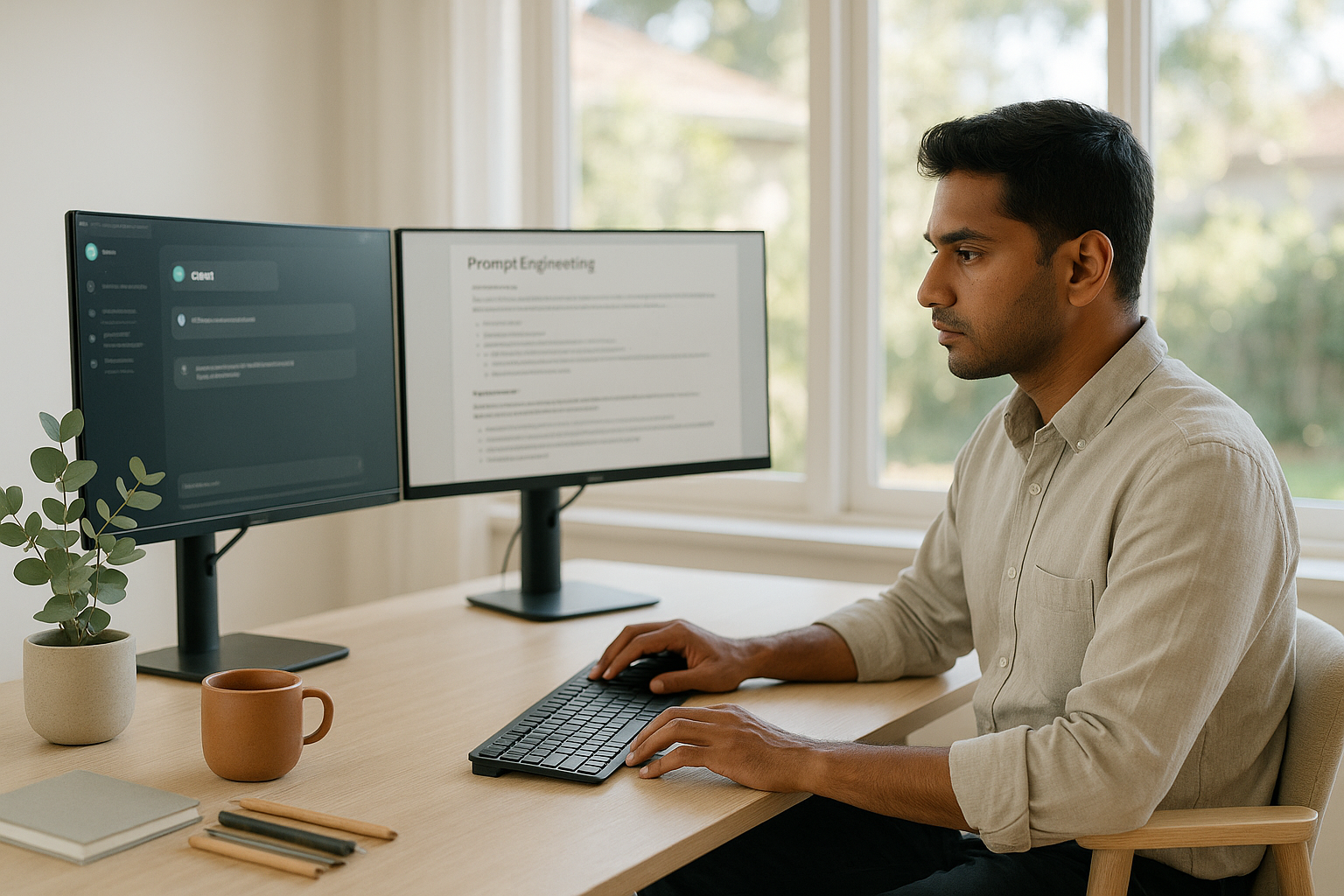
How to Become a Freelance AI Prompt Engineer in Australia and Charge $80/Hour
The first time someone paid me to write prompts, I charged $35 an hour and felt slightly guilty taking the money. That was early 2024. By the back half of that year, the same kind of work — building a repeatable prompt library for a Brisbane real estate agency so their admin team could draft property descriptions in minutes — was going out the door at $85 an hour, and the client thought it was a bargain. Nothing about my technical ability changed much in those months. What changed was how I packaged the work, who I sold it to, and the fact that I stopped calling myself a "prompt engineer."
General information only. Income figures in this article are estimates based on publicly available reports and community discussions — results vary significantly based on effort, niche, and market conditions. This is not financial, legal, or tax advice. For guidance specific to your situation, consult the ATO, a registered tax agent, or a qualified professional.
I went looking for reliable Australian guidance before I wrote this, and honestly, there's almost nothing usable. Half the official pages I tried to reference were broken. The good guides are American, which means they ignore your ABN, your GST threshold, and the way the actual money flows here. So this is a from-the-trenches piece rather than a polished overview.
What an AI prompt engineer actually does (and doesn't)
Forget the mythical six-figure "Prompt Engineer" job title you saw splashed across headlines in 2023. That role — sitting inside a tech company, fine-tuning prompts all day — is already fading. If you check seek.com.au today, you'll find far fewer salaried "prompt engineer" listings than you would have eighteen months ago.
What's grown instead is freelance demand. Australian businesses aren't hiring prompt engineers as staff — they're paying contractors to set up AI workflows for the team they already have. That's a critical distinction. The work is practical: you sit with a business, work out where AI could save them hours, then build the prompts, custom GPTs, and automations that make it happen reliably. You're closer to a workflow consultant than a wordsmith.
Is this still a real career in 2026? The honest answer
Yes, but not the version most people imagine. The skill of typing a clever sentence into ChatGPT is being commoditised — the models keep getting better at understanding sloppy instructions, so raw prompt-writing alone is a shrinking market.
What's durable is the combination of prompt design plus a specific industry's knowledge plus automation. A useful signal: Upwork now runs a dedicated "Claude Experts" category, separate from general AI consulting, and an "N8N Experts" category for no-code workflow automation. The platform only carves out a vertical when there's enough buyer demand to justify it. The fact that prompt work sits right next to automation tells you where this is heading — clients want someone who can wire AI into their actual processes, not just hand over a clever paragraph.
Realistic rates: why $80/hour is achievable here
Let's talk actual money, because this is where the US guides become useless.
In your first one to three months, expect $900–$1,500 AUD a month. That's one or two clients, charging maybe $40–$55 an hour while you build a portfolio, with platform fees skimmed off the top. It's slow and slightly demoralising. That's normal.
Six to twelve months in, with consistent effort and three to five regular clients, $2,500–$4,500 a month is realistic — roughly 20 hours a week at $65–$85 an hour, mixing one-off builds with retainer work. The top 10%, the ones who've niched hard into legal, real estate, or e-commerce and bundle custom GPT builds with retainers, push into $7,000–$12,000 a month. A chunk of that ceiling comes from US-dollar Upwork clients, where the exchange rate quietly inflates your effective AUD rate.

Here's the thing nobody tells you: hourly billing is often the worst way to charge. Small business clients flinch at "$80/hr for six hours" but happily pay "$500 for a 20-prompt library." Same money, different psychology. Quote the outcome, not the clock.
The skills to build first — no CS degree required
You don't need to code. You do need provable, niche-specific expertise, because "I'm good with ChatGPT" describes about four million Australians and is worth nothing.
Start with the fundamentals properly. Work through OpenAI's prompt engineering documentation and their guide to building custom GPTs — it's free and it's the actual source material. Then layer on one automation tool: Zapier or N8N. The moment you can connect a prompt to a trigger — a new email comes in, a GPT drafts a response — you've moved from "person who writes prompts" to "person who builds systems," and that's the defensible position.
Practise on tools you'd expense anyway: a ChatGPT Plus subscription, Claude Pro at whatever the current rate is when you're reading this, maybe Midjourney's paid plan if you're doing anything visual (check their site for current pricing). As general guidance, these are likely deductible as tools of trade once you're operating as a business — but verify your specific situation with a registered tax agent.
Choosing a niche: boring beats sexy
The counterintuitive truth I learned the hard way: niching into a dull industry beats chasing tech startups. I spent a month pitching myself as a generic "AI consultant" and got nowhere. The calls that converted were the boring ones — real estate admin, aged care documentation, trade business quoting.
Why? Because a plumber drowning in quote requests has a specific, painful, expensive problem, and almost no one is solving it for them. A tech startup already has three people who can prompt. Pick an industry where you understand the jargon and the pain — even better if you've worked in it. A composite example: Priya in Adelaide, who'd done five years in conveyancing, now builds prompt templates for small legal firms to draft routine client correspondence. She knows what a "section 32" is. Her competitors don't. She closes nearly every call.
How to package your services
This is the question every guide skips. What do you actually hand over?
Three offers cover most of the market:
- A prompt library — a Notion or Google Doc deliverable with 15–25 tested, documented prompts for a specific task, plus instructions on how to tweak them. Scope it tightly: "20 prompts for property listing copy, two rounds of revisions." That last clause is what saves you from scope creep.
- A custom GPT build — a configured GPT loaded with the client's tone, templates and rules, so their team gets consistent output without learning to prompt at all.
- An AI audit — you review how a business currently works, identify three to five tasks AI could handle, and deliver a roadmap. Often this becomes the gateway to the bigger build.
Define "done" in writing before you start. The fastest way to lose money is an open-ended brief.
Where to actually find clients
Platform choice is an income strategy, not a preference.
Airtasker is full of price-sensitive local clients who rarely pay above $50–$60/hr for AI work. Treat it as a portfolio-builder, not a living. Upwork is where the rates live — its international, often US-dollar-paying clients can yield the $80–$120 AUD equivalent that makes this worthwhile. One trick: on Upwork, don't list yourself as a "prompt engineer." Use the labels clients actually search — "AI Workflow Automation," "AI Integration," "AI Consultant." Upwork takes a flat 10% fee, so price that in.
LinkedIn and direct local outreach is the slow-burn channel that produces your best clients. Post about a specific problem you solved, message businesses in your niche, offer a free 20-minute audit. Most clients have never heard "prompt engineer" — when I describe myself as an "AI workflow consultant," I close roughly twice as many calls. The label matters more than it should.
If you're coming from a writing background, the path I describe in how Australian freelancers are using ChatGPT to land $50/hour writing gigs on Fiverr overlaps heavily — same skills, different packaging. And if a client asks about customer service automation, that's its own lucrative adjacent service, which I cover in how Australian small businesses will pay you $500+ to set up AI customer service chatbots.
Building a portfolio with no clients
Make your own case studies. Pick three industries, build a sample prompt library for each, and write up the before-and-after: "Manual property description took 15 minutes; this prompt takes 90 seconds." That's proof. Offer your first one or two real jobs at mate's rates in exchange for a testimonial. Nobody hires the freelancer with an empty profile.
The business side, without the lecture
Before you invoice a single client, get an ABN. It's free, it takes minutes through the Australian Business Register, and you'll need it to operate legitimately. I've written a fuller breakdown in do you need an ABN for AI side income, but the short version: every dollar of self-employment income is assessable and must be declared in your annual return, regardless of how small.
As general guidance based on ATO information, GST registration only becomes mandatory once your turnover hits $75,000 a year — at $80/hr that's about 18 billable hours a week, so most part-timers stay under it for the first year and don't charge GST at all. Verify current thresholds at ato.gov.au or with a registered tax agent.
The genuine trap nobody warns you about: Personal Services Income rules. If more than 80% of your income comes from a single client, the ATO may treat you differently and restrict the deductions you can claim. It's exactly the situation a new freelancer with one big retainer falls into. Worth understanding early, and worth a conversation with a tax agent before it bites.
Scaling beyond the hourly grind
The freelancers who break past $5,000 a month stop selling hours. They turn that real estate prompt library into a productised offer — a fixed $1,200 package sold to ten agencies instead of one. They convert one-off builds into monthly retainers where they maintain and improve a client's AI workflows for a recurring fee. That's where the income stops scaling with your fatigue and starts compounding.
I charged $35 an hour because I was selling my time and didn't know what it was worth. The shift to $85 wasn't about working harder — it was about selling a result to a business that genuinely needed it, and being specific enough that they couldn't get it anywhere else.
Author


