Using Midjourney to Sell Print-on-Demand T-Shirts to Aussie Customers (Redbubble vs Amazon Merch)
I went to read Redbubble's official Australian seller FAQ before writing this. It's a 404. So is Finder's print-on-demand income guide. So is the ATO's self-employment income page I wanted to link. The single most authoritative Australian sources on this exact topic are, as I write this, dead links. That's not a tangent — it's the whole problem. Australian POD advice is mostly recycled US content, and the official pages that should fill the gap have quietly fallen over.
So here's the honest version, built from what actually happens when an Australian signs up, generates designs in Midjourney, and tries to get paid in Australian dollars.
General information only. Income figures in this article are estimates based on publicly available reports and community discussions — results vary significantly based on effort, niche, and market conditions. This is not financial, legal, or tax advice. For guidance specific to your situation, consult the ATO, a registered tax agent, or a qualified professional.
What you're actually signing up for (and the income you can expect)
Print-on-demand means you upload a design, the platform prints it on a shirt only when someone buys, and you take a cut. No stock, no postage, no garage full of XL hoodies. Midjourney handles the artwork; the platform handles fulfilment. Your job is the bit in between — concept, niche, file prep, and tags.
The numbers, plainly: in your first one to three months you'll likely make $50–$150 AUD a month, and honestly the low end is more common — single-digit sales, royalties of $2–$8 per shirt at default markup. Plenty of new sellers do $12 in month one and quietly question their life choices. Push through to six or twelve months with 50–150 designs live, consistent tagging and a tight niche, and $300–$800 AUD a month becomes realistic. The top 10% — people with 300-plus evergreen designs across multiple platforms — sit around $2,000–$2,500 AUD a month, occasionally higher. For Australians specifically that ceiling is compressed, and the reason is Amazon, which we'll get to.
These figures come from community-reported numbers on r/redbubble, r/AusFinance and Whirlpool threads — not audited data. Treat them as the shape of the thing, not a promise.
Can you legally sell Midjourney designs?
Short answer: yes, with conditions that matter.
If you're on a paid Midjourney plan (Basic and above — see their site for current pricing), Midjourney's Terms of Service grant you commercial rights to the images you generate. Free and trial generations sit on a public grid where Midjourney retains broader rights, so don't build a business on those.

The gotcha isn't Midjourney's licence — it's what the model occasionally produces. Midjourney can hallucinate a recognisable character, a celebrity's face, or mimic a named living artist's style. Midjourney granting you commercial use does not mean the output is free of third-party IP. And Redbubble's copyright policy is blunt: the seller carries the infringement liability, not the AI tool. If your "generic superhero" looks a bit too much like one Disney owns, that's your problem, not Midjourney's.
There's a second, messier issue. Since around mid-2023, Redbubble has reportedly become more aggressive about removing obviously AI-generated work — photorealistic faces, unmodified Midjourney outputs, that signature over-rendered look. The platform still hasn't published a formal AI-art policy (you'll find general guidance in the Redbubble Help Centre, but nothing definitive on AI). What survives moderation, anecdotally, is work where the AI is the base and a human has done real layering — original typography, layout, a genuine concept. A raw Midjourney render of "cool koala" gets flagged. A Midjourney koala you've cut out, placed into a designed composition with hand-chosen text and a clear joke survives. "Adding a human creative layer" isn't a slogan; it's the difference between a live listing and a takedown email.
If this whole space interests you, it's worth reading my piece on selling AI-generated art on Etsy from Australia with Midjourney — Etsy's a different beast with its own moderation quirks, but the design-prep thinking carries over.
Redbubble vs Amazon Merch: the honest Australian comparison
For most Australians, this isn't really a choice. Let me explain why.
Redbubble is one of us — Melbourne-founded, ASX-listed. You can sign up today, no invite, no waitlist. You set your own margin on top of a base price, and Redbubble pays monthly via PayPal once you clear a minimum threshold (around US$20). Here's the catch that frustrates new sellers: payouts are in USD, which PayPal converts to AUD, and earnings under the threshold roll over rather than paying out. So your first $14 month feels invisible — it just sits there until you cross the line. A classic tee at a 20% markup nets you roughly $3–$6 AUD per sale.
Amazon Merch on Demand is the better-paying platform on paper, and for most Aussies it's a closed door. It's invite-only globally, and Australians without an existing US Amazon seller history report waitlists measured in months to years. Whirlpool users have called it "invite-only with a two-year waitlist for Aussies." Even if you get in, two problems bite. First, royalties are USD, and after PayPal or Wise conversion the margins erode — one seller described earning US$47 in a month that netted AU$58 after fees, calling it "barely worth it unless you're doing serious volume."
Second, and this is the one nobody warns you about: US withholding tax. Amazon defaults to withholding 30% of a non-resident's royalties for the IRS. To drop that to the 5% treaty rate, you must file a W-8BEN form inside your Merch account's tax settings, claiming the US–Australia tax treaty. Australians who skip this — and many do — silently hand 25 cents of every dollar to the IRS for no reason. You'll need your name, Australian address, and tax identification details to complete it. File it before your first sale, not after.
The practical verdict: start on Redbubble. Treat Amazon Merch as a "maybe later" if you scale and can stomach the friction.
Designs that actually sell, and the niches that work here
The mistake is prompting "t-shirt design" and uploading whatever Midjourney spits out. Specificity wins. Think in terms of who buys a shirt about a thing — hobbies, professions, in-jokes, identity.
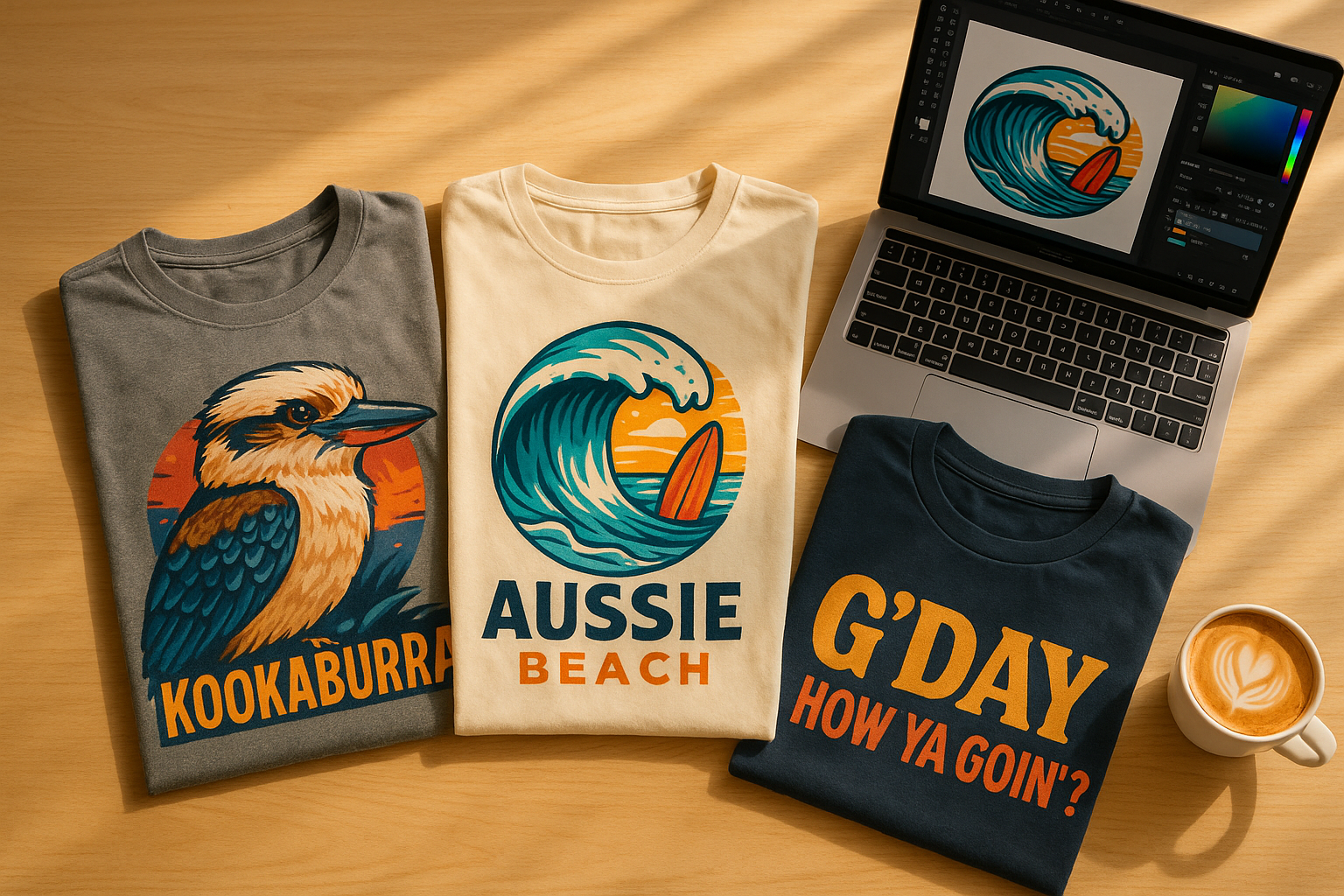
For the Australian market specifically, the evergreen veins are footy culture, native wildlife with personality (quokkas, wombats, a galah mid-screech), regional pride, and our slang done well rather than as a tired "G'day mate" cliché. A composite example: Priya, a 34-year-old in Adelaide, builds a tight collection around AFL crowd culture and SA-specific in-jokes — nothing using club logos or player names (that's straight into trademark trouble), just the feeling of being a long-suffering supporter. She generates illustrated base art in Midjourney, adds her own hand-set typography in Canva, and lists across both shirts and stickers. Three months in she's averaging around $280 AUD a month, most of it from a handful of designs that found their people. Not life-changing. Real, though, and growing.
Useful prompt directions tend to combine a clear subject, a print-friendly style ("bold vector illustration," "flat colour," "limited palette"), and crucially a request that avoids photorealism — which both prints poorly and triggers AI moderation. You want clean, graphic, intentional.
Getting files print-ready
This is where amateurs lose sales they never knew they had. Upload requirements are unforgiving: aim for at least 4500 x 5400 px, a transparent background (PNG), and genuinely clean edges. Midjourney doesn't output transparency, so you'll cut backgrounds out yourself — Canva's background remover or any decent editor handles it, but check the fine edges, because halos and stray pixels are what make a design look cheap on a coloured shirt. Limited colour palettes print sharper and survive washing better than muddy gradients.
Tax, GST, and the thing everyone gets wrong
Here's the most practically important fact in this entire article, and almost every guide either omits or mangles it.
Under Australian GST law, Redbubble and Amazon are "electronic distribution platforms." That legally makes them responsible for collecting and remitting GST on sales to Australian customers — not you. So if you're earning $150–$800 a month, you are nowhere near the $75,000 GST registration threshold, and you do not need to be GST-registered to sell on these platforms. Verify current obligations at ato.gov.au or with a registered tax agent, but this is the rule that saves Aussie sellers a lot of needless panic.
What you do need to do: report the income. As general guidance, POD royalties — including foreign-sourced ones from Amazon — go on your Australian tax return as business income if you're operating with commercial intent and repetition, which a real POD store is. Most sellers run as sole traders, and an ABN becomes sensible once you're treating this as a business rather than a hobby; I've unpacked exactly where that line sits in do you need an ABN for AI side income. Your Midjourney subscription, at roughly $21 AUD a month, is potentially deductible if the activity qualifies as a business — and the mechanics of claiming that, alongside how to report everything cleanly, are covered in how to declare AI side hustle income on your Australian tax return.
Getting Australian eyes on your store
Redbubble's internal search does heavy lifting, so your tags and titles matter more than anything — describe the design honestly, the subject, the vibe, the occasion, without keyword-stuffing rubbish. Beyond that, Pinterest remains the quiet workhorse for POD because it behaves like a visual search engine with a long shelf life, and Instagram works if your niche has a community to plug into. The sellers who reach the upper end aren't necessarily better artists — they've just been consistent for six months while their listings slowly accumulated search authority.
So should you bother? If you want a fast return, no. If you'll genuinely enjoy making 50 designs before you judge whether it's working, and you treat the first few near-empty payout months as the cost of learning — then yes, this is one of the lower-risk Australian side hustles going. Start on Redbubble. Add the human layer. File the paperwork. And don't quote me on Amazon's waitlist — check it yourself, because by the time you read this, half of what I've described will have changed its terms again.
Author


